A HIPAA-Compliant Phone System That Turns Missed Calls Into Conversations
Carrick handles the calls your clinic can't get to — routing patients to the right person, transcribing every voicemail, and turning each missed call into a two-way text in the same shared inbox as the patient's messages and forms. HIPAA and PIPEDA/PHIPA compliant, with a signed BAA on every plan. Works alongside your existing phone lines.
A missed call is a missed patient. When the line is busy and voicemail is a dead end, the patient books elsewhere. Carrick closes that gap: the call that does not get answered becomes a text the patient can reply to in seconds, and the front desk works from one place instead of a phone, a voicemail box, and a callback list.
This page covers what a HIPAA-compliant phone system is, why missed calls cost clinics patients, and how Carrick's calling, routing, and smart voicemail recover them.
What is a HIPAA-compliant phone system?
A HIPAA-compliant phone system is a cloud (VoIP) telephone platform for healthcare organizations that protects patient information wherever it appears in voice communication — live calls, recorded or transcribed voicemail, and call metadata.
A standard business phone line does not meet this bar: voicemail content, call recordings, and call logs all contain protected health information, and on a consumer or generic business system, none of it is access-controlled, audit-logged, or covered by a BAA. A HIPAA-compliant system closes every one of those gaps:
Encryption in transit and at rest for live audio, voicemail recordings, and transcripts.
Role-based access controls so only authorized staff can hear a voicemail or read a transcript.
Complete audit logging of who accessed which call record and when.
A signed Business Associate Agreement (BAA) in which the vendor accepts legal responsibility for the data.
Beyond that compliance baseline, healthcare-specific systems typically add automatic call routing to the correct department or on-call staff, a virtual receptionist for after-hours coverage, secure voicemail with transcription, and text messaging from the same number. For Canadian providers, PIPEDA and PHIPA apply and require patient call data to be stored on Canadian servers.
Why missed calls cost clinics patients
When a patient call goes unanswered, the patient often does not call back — they book elsewhere or skip care entirely. Front-desk voicemail makes it worse: no one sees the message in context, callbacks pile up through the day, and there is no record the patient was ever reached.
NL Health Services cut inbound call volume 50% by moving routine call reasons to text — and every one of those calls used to be a chance to lose the patient in the hold queue.
The failure modes Carrick removes:
Busy signals and hold times that send patients to a competitor.
Voicemail no one triages until hours later, if at all.
Callback tag where staff and patient keep missing each other.
No shared record of what the patient called about, so the next staffer starts from zero.
After-hours calls that hit a generic mailbox with no routing or urgency handling.
How Carrick handles voice and voicemail
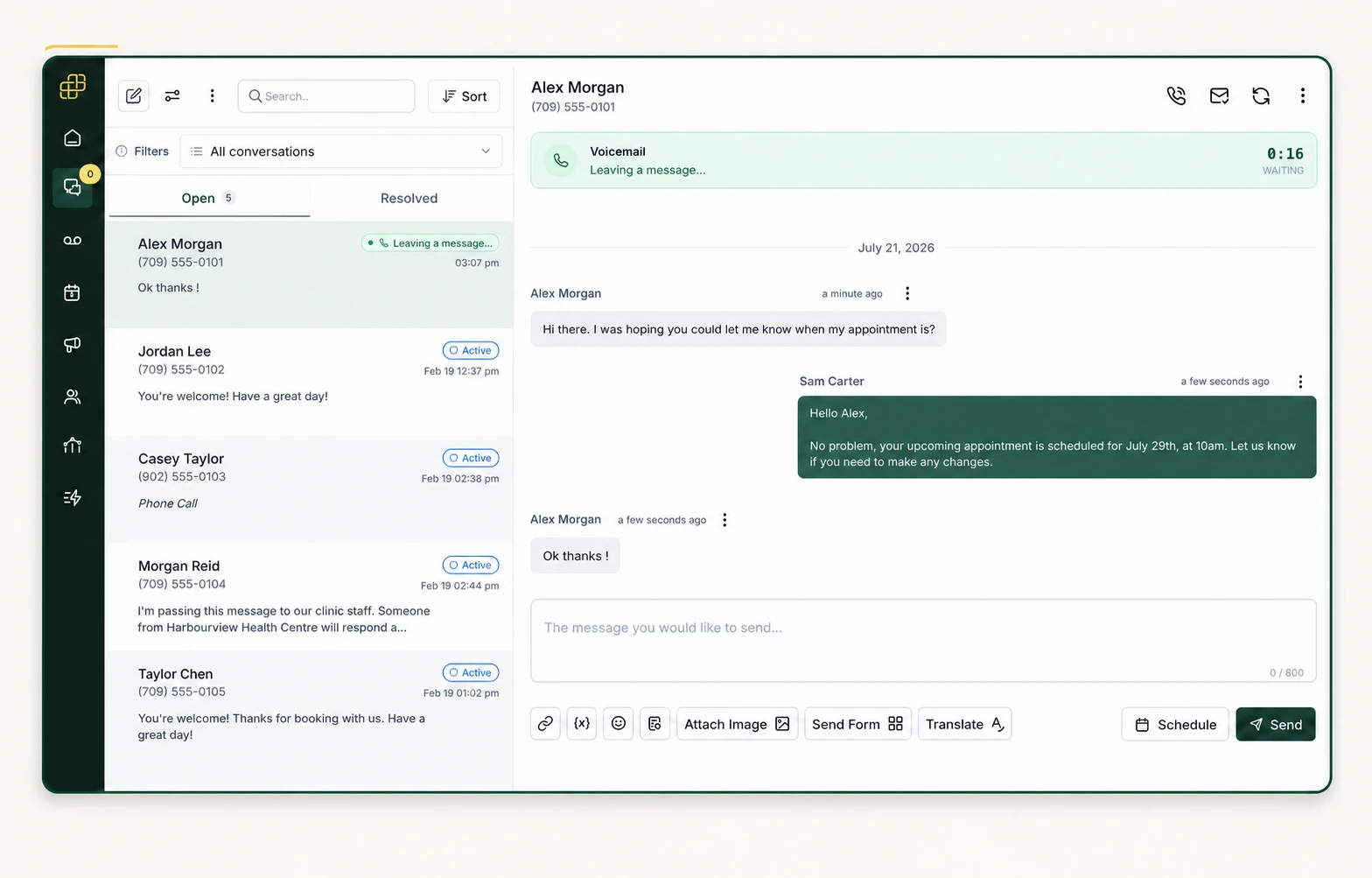
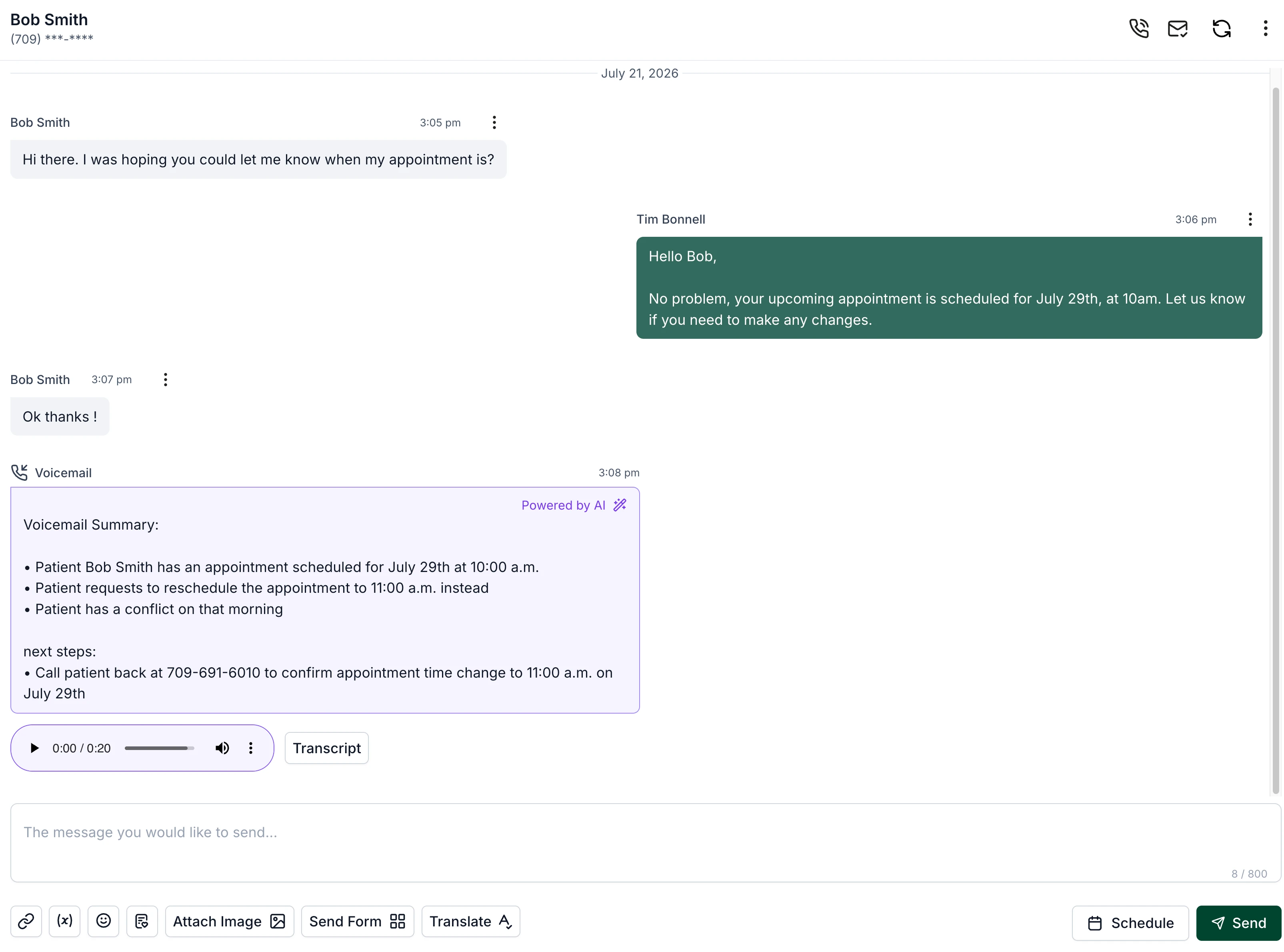
Carrick adds a patient-communication layer to your phones: calls route to the right person automatically, unanswered calls convert to text, and every voicemail is transcribed into the patient's thread. Staff triage from the shared inbox instead of dialing into a mailbox.
Smart call routing
Send patients to the right person, department, or on-call staff automatically, with rules for business hours, overflow, and after-hours coverage. Urgent calls reach a person; routine ones can be offered a text or callback.
Missed-call-to-text
Every unanswered or busy-line call automatically opens a two-way text to the patient. The patient gets a message they can reply to immediately, and the conversation lands in the shared inbox with their full history attached.
Voicemail transcription
Every voicemail is transcribed and filed in the patient's thread. Staff read and triage voicemails the same way they handle texts — no dialing in, no replaying messages, no lost callbacks.
One number for calls and texts
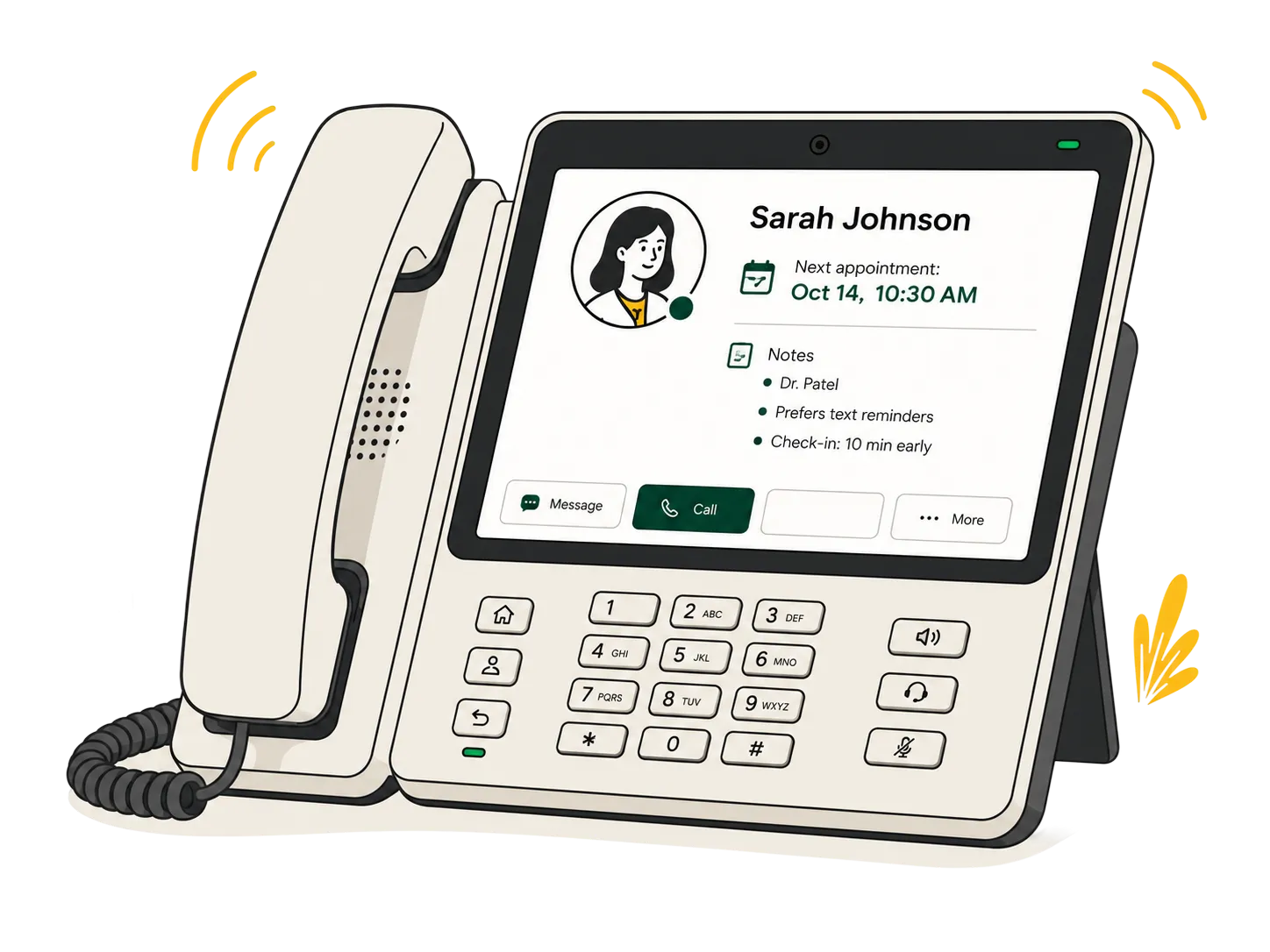
Patients call and text the number they already know. Staff work both channels from one place, with the same patient record open.
Built for healthcare, compliant in the US and Canada
Carrick applies the same safeguards to voice that it applies to text: encryption in transit and at rest, role-based staff access, complete audit logging, a signed BAA on every plan, and Canadian data residency for voicemail recordings and call logs. Compliance is built in, not configured.
Carrick works alongside your existing phone infrastructure. Patients keep calling the number they know; routing, transcription, and missed-call-to-text run on Carrick. Practices that want to consolidate can move more of their voice operations onto Carrick over time, at their own pace. See how Carrick meets HIPAA requirements for patient communication.
Proof — NL Health Services
NL Health Services moved routine call reasons — reminders, confirmations, and simple questions — to text and automated follow-up across 30+ clinics. Inbound call volume dropped 50% and preventable no-shows dropped 80%, freeing front-desk staff for the calls that actually need a person.



















It has significantly reduced the time staff spend calling patients and responding to voicemail. It allows the program to reallocate time to other clinical and administrative tasks. As well, patients are finding it much easier to contact the clinic, ask questions, and book or adjust their screening appointments.
Greg Doyle
Provincial Manager, Breast Screening Program, NL Health Services
Stop losing patients to voicemail.
Book a demoFrequently asked questions
What is a HIPAA-compliant phone system?
A HIPAA-compliant phone system is a cloud calling platform that protects patient information across live calls, voicemail, and call records through encryption, access controls, audit logging, and a signed Business Associate Agreement with the vendor. It usually adds healthcare features such as smart routing, after-hours answering, and secure voicemail transcription. Carrick provides these controls on every plan.
Is a normal business phone system HIPAA-compliant?
No. A standard business phone line or consumer voicemail is not HIPAA-compliant because call recordings, voicemail content, and call logs are not access-controlled, not audit-logged, and not covered by a Business Associate Agreement. A healthcare organization needs a phone platform where the vendor signs a BAA and secures every part of the call.
Does a HIPAA-compliant phone system replace our current phones?
Not necessarily. Carrick's calling and voicemail features work alongside your existing phone lines — patients keep calling the number they know, while routing, transcription, and missed-call-to-text run on Carrick. Practices that want to consolidate can move more of their voice operations onto Carrick over time.
How does Carrick's phone system handle missed calls?
When a call is unanswered or the line is busy, Carrick automatically opens a two-way text conversation with that patient and files it in the shared inbox alongside their message history. Staff see the missed call flagged with context and can reply by text or schedule a callback, so the patient is never left to call back on their own.
Is voicemail transcription in a HIPAA-compliant phone system secure?
Yes, when the platform encrypts the audio and the transcript, restricts access to authorized staff, logs every view, and is backed by a BAA. Carrick meets all of these conditions and stores Canadian providers' voicemail data on Canadian servers for PIPEDA and PHIPA.
Is Carrick's phone system compliant for clinics in Canada?
Yes. Carrick meets HIPAA for US providers and PIPEDA and PHIPA for Canadian providers, including Canadian data residency for call logs and voicemail. A signed Business Associate Agreement is included with every plan.